Monday, 16 June 2014

A busy week! - Looking for new ideas in perspectives & Life Drawing - Millennium Gallery

It's been a busy week since I last blogged!  - I've spent a fair amount of time building up my drawing practice through continuing the exercises in Betty Edwards book, Drawing on the right side of the brain.

I've also done my first truly commercial piece of work too, whichI'm glad to say my customer was delighted with! - This was a project to re-design and bring up to date a set of company logos and banners for a local motor engineering and car sales firm, the Managing Director of which is an old school chum from some 40+ years ago, with whom I have recently got reaquainted with in the last couple of years.

I had earlier mentioned in conversation at a few social events, that I was studying contemporary art and illustration as a potential career change, and I think as a result of this he telephoned me last week and asked me pretty much outright, - accepting "that it may not be my bag", and he wouldn't be offended at all if I said no, but if I would be interested in giving his 20 year old business branding a bit of a make-over.  Whilst this wasn't ever a direct "sales" pitch or approach from me, per se, I still jumped at the chance; I arranged a short meeting with him to discuss what he was looking for, and set some very basic commercial framework for us to work with.  He accepted my proposal and I took about a day and a half to provide him with a new logo, yet retaining the existing brand image he had built over the last 20 years.
The following day after emailing him some .pdf samples, he actually took the time out of his schedule to call me and thank me for my designs, - he went on to say that over the last 20 years he's tried a number of graphic designers to come up with new logos, but none of them matched up to me in the fact that I had been the "first to actually listen and deliver exactly what he wanted!" - I was delighted!  He didn't need to have said this, it was sincere and humbling praise which means a huge amount to me!...  So I have been on cloud nine for a couple of days since then!

I've also taken another slight excursion into something new to experiment with too, and that is the drawing of pets and animals.
My first serious attempt has proved reasonably successful, having taken on the ideas of focussing on light & shade to find patterns of forms rather than trying to capture the whole (the Gestalt) in one interpretation, - object patterns or shapes that are unfamiliar seem to be so much more easier to capture.  It's more transcendent almost, to capture the independent shapes that make up a whole object, and render them (almost like the pieces of a jig-saw puzzle), rather than attempt to render the whole object or subject in one artistic flourish.
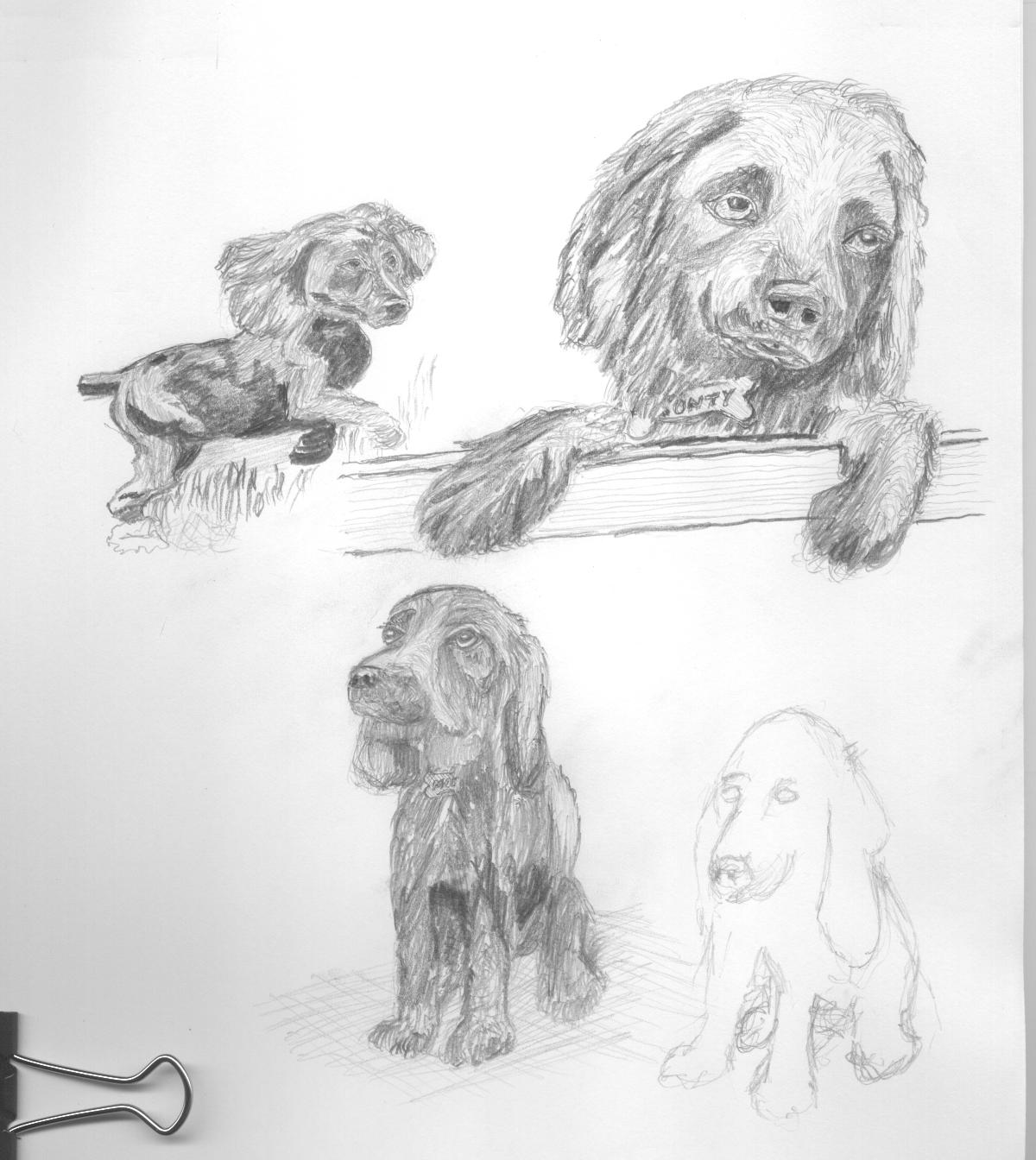


My continued exploration of using these negative space 'queues', are making, quite simply, for better drawing outcomes.  The following examples are my lead up to the latest pieces of work...


So, on to the life drawing that I did this Friday (13th June visit)...  Well, I was a bit taken aback by the model, "Patrick" today, he must have been 6 foot 2" and very, well, normal! - He was certainly not a bloke you might have expected to be a male model (unlike the previous David, who's physique was not unlike Michelangelo's boy David!)...  No, I'd have expected to see Patrick down the boozer propping up a bar, so he made for a much more interesting study.

 We started off with six very quick, 5 minute sketches to just get the general flow of things.


Followed by  a more detailed 15 minute study

I'm trying tounderstand the secret to finding negative spaces here, and also trying to apply a more angular expression to my drawings.


The next drawing (Below left) had a foreshortened knee pointing towards the viewer, I hadn't got this right at all...
  
But then it seemed to click after a conversation with the tutor, he was extremely helpful and pointed out that the initial feel of a drowing is always about straight lines and angles and angular relationships when drawing males, - however, this straight line form is changed to curves when drawing females.

Tuesday, 10 June 2014

Continuing drawing transformations - Negative Spaces

I spent some time today re-immersing myself in Betty Edwards "Drawing on the Right Side of the Brain" (Penguin Group, 2013), and conducted a little experiment.

Interesting results... In the first sketch, I used Betty Edwards approach to sketching, and I performed in a very methodical and systematic way, - as her book prescribes.  This is the result of about 45 minutes work;

Whearas, in this second sketch, I just did my usual thing, - I sketched freehand, using my normal process of building up the image based purely on my internal schemas to draw the garden chair.

I think (in some way to my confusion)... that the first drawing, that followed the Betty Edwards process, is a lot better! - It looks more accurate, it is more finished, and overall, I think it has much more going for it!

SO, LESSON LEARNED! - I NEED TO DO THIS COURSE!!!

Back to the drawing board for me then.... Drawing negative spaces makes for a much better drawing!

Saturday, 7 June 2014

Visits to the Millennium Gallery and the Graves Gallery, Sheffield

I had an opportunity to start a session of Life Drawing classes today, held at the Millennium Gallery for contemporary art, Sheffield.  The tutor was Brian Smith, who is also a lecturer at Hallamshire University, Sheffield, and interestingly, informed me he was an Architecture Student of Huddersfield (when it was a poly-technical college), prior to its becoming a University.

I thouroughly enjoyed the Life Drawing, - Brian provided me with valuable tuition in a number of points, so much in fact, that I felt a little self concious that he spent so much time with me, compared to the other 15 or so students.

In particular, he explained the relational equilateral triangles that I should look out for on the human form, and try to make everything conform to equilateral reference points, rather than skewed or isosceles triangles, that novices tend to fall in to.   Furthermore, to work the human form with circles and tangents rather than the line on its own provides a better relationship to forms.   Very useful and valuable advice.

Vincent Van-Gogh, - Diggers
The additional advice provided was to work more on searching out shapes, not specifically human forms. Once identified in isolation, the shapes and shades and tonal values can be more easily recorded, rather than trying to complete a picture or likeness through viewing the whole.  This takes quite a mental mind shift, but it's results are far more accuracy in deliniating the gestalt. (The whole).

Vincent Van-Gogh, Digger
This is really about looking for negative spaces too.  In reference to Betty Edwards book, Drawing on the Right Side of the Brain, (2012, Penguin Group),  it's a technique that is most apparent in many of the paintings by Vincent Van-Gogh, and to some degree, his friend Paul Gougan.  In Van-Gogh's drawing of "The Digger", (On the right here) this negative space drawing technique has particular importance as the figure on first glance seems to have extreme facial features. However, the positioning of the face and the silhouette of the mouth and nose and lips is actually appropriately and (paradoxically) proportionately placed.  Van-Goch also increased the contrast between the dark areas of the body & form and the negative space of the background pond and water rushes.


The Life Drawing lesson lasted two hours and I intend to use these again, especially as I can get student discount too!...  I've committed to do these every Friday morning, whenever I am free / available to do so.

My rather feeble results from today's session are as follows, and in no way at all could be compared to the genius of Van-Goch's examples above, - however with Brian's tuition, I seemed to be getting a little better after each of the model's poses which were timed at between 5 minutes to 15 minutes.

You can see from the two drawings on the left, - in the upper one (which is my clearly novice attempt), I have tried to copy the "form" of the model's upper torso. - The head, the arm, the shoulder, the neck, the chest and so on.  Whearas in the tutor's drawing (at left, lower), you can see that the focus of his attention was only on drawing or copying, shapes such as the shadow area under the chin, the triangular shape of shadow to the right of the arm-pit, the shape of the negative space between arm and head, the angle of the boundary line between the fore-arm and above, the shape of the negative space to the right of the head, etc.  Notice that these are referred to as just shapes, just lines or tangents and just shapes or spaces... There is no labelling of the objects for what they are, - they are just shapes.   This mental shift in normally trying to define and visualise the objects in our heads before deliniating them, rather than as a professional artist does, which is not to name but to DRAW takes us into a very different technique.  I'm sure you will agree that the result, i.e. the lower of the two drawings, carries much more weight, depth, artistic gravitas if you like, than my feeble attempt above it!
 So, Onwards and Upwards....  I clearly need to make this transformational shift in my drawings and to start to look and record in terms of;


  • Tangents and lines coming from circles or elipses
  • Angles - to be defined early and used as reference points
  • Negative spaces and shapes which are just as, if not more important than the object forms you are trying to capture
  • Shapes and random patterns, that are more easily recorded, 

(TANS)

....rather than trying to draw an object that has probably got it's original dimensions and drawing procedure locked in your brain, but hasn't changed since childhood... - See example on the right of my attempt to draw based on this -pre-programmed method, which looks very basic, amateurish and crude.  Even the best of the attempts, below right, still has this novice and un-sophisticated quality to it.
 I clearly have much to learn!